
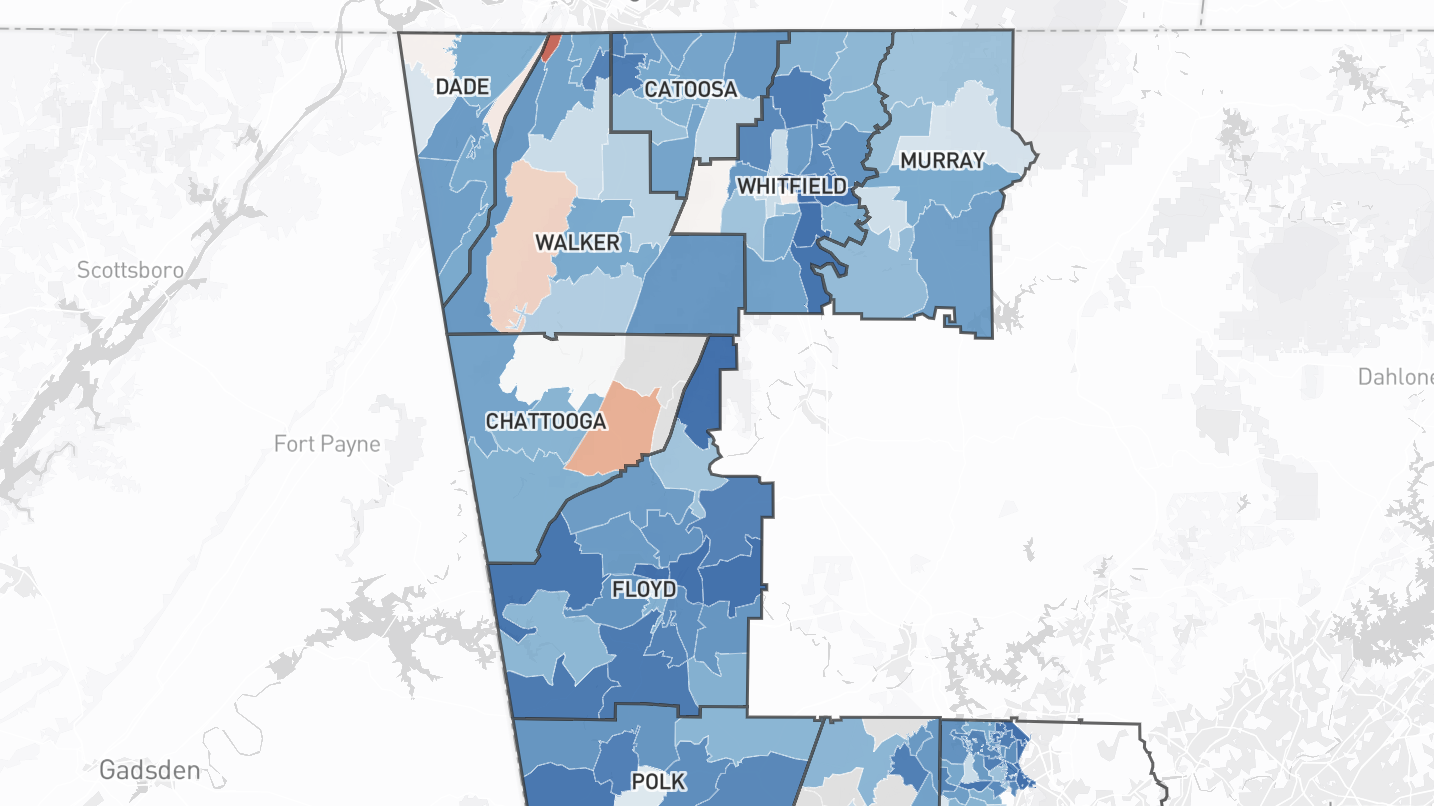
Results in this article are from the Georgia Secretary of State’s official election export for the March 10, 2026 special election. For interactive precinct-level data, see our GA-14 Results Dashboard.
The Result
Democrat Shawn Harris won a plurality of votes in the GA-14 special election with 43,241 votes (37.3%), triggering a runoff. Republican Clay Fuller finished second with 40,388 votes (34.9%). The remaining 15 candidates split 27.8% of the vote.
The aggregate party totals tell the clearer story:
| Party | 2024 Congressional | 2026 Special | Change |
|---|---|---|---|
| Republican | 243,446 (64.4%) | 69,107 (59.7%) | -4.7pp |
| Democrat | 134,759 (35.6%) | 46,111 (39.8%) | +4.2pp |
| Other | 0 | 602 (0.5%) | — |
| Total | 378,205 | 115,820 | -69.4% |
The Democratic vote share increased 4.2 percentage points, from 35.6% to 39.8%. Because the Republican share moved in the opposite direction (-4.7pp), the two-party margin shifted by 8.8 points — from R+28.7 to R+19.9.
Every County Shifted Toward Democrats
The most notable feature of this result is its uniformity. All 10 counties in GA-14 saw their Democratic vote share increase compared to the 2024 congressional race.
| County | 2024 D% | 2026 D% | D Share Change | 2024 Margin | 2026 Margin |
|---|---|---|---|---|---|
| Floyd | 33.6% | 41.3% | +7.7pp | R+32.9 | R+17.1 |
| Polk | 22.9% | 29.6% | +6.7pp | R+54.3 | R+40.3 |
| Whitfield | 33.9% | 40.4% | +6.5pp | R+32.2 | R+18.8 |
| Catoosa | 27.3% | 32.1% | +4.8pp | R+45.5 | R+35.4 |
| Cobb | 48.6% | 52.6% | +4.0pp | R+2.7 | D+5.9 |
| Dade | 21.5% | 24.8% | +3.3pp | R+57.1 | R+49.9 |
| Paulding | 40.6% | 43.5% | +3.0pp | R+18.9 | R+12.3 |
| Murray | 18.5% | 21.5% | +2.9pp | R+63.0 | R+56.8 |
| Walker | 25.5% | 28.4% | +2.8pp | R+48.9 | R+42.7 |
| Chattooga | 24.0% | 26.0% | +2.0pp | R+52.0 | R+47.4 |
Three patterns stand out:
Floyd County led the shift with a 7.7 percentage point increase in Democratic vote share. This is a county where Greene won by 32.9 points in 2024; Democrats closed the gap to R+17.1. Floyd’s urban center (Rome) and its surrounding precincts appear to have driven this.
Cobb County flipped from R+2.7 to D+5.9. Cobb’s 30 GA-14 precincts sit on the northwestern edge of metro Atlanta and were already the most competitive part of the district. A 4.0pp shift was enough to push aggregate Cobb results into Democratic territory.
The deepest-red counties also moved. Polk (+6.7pp), Murray (+2.9pp), and Dade (+3.3pp) all shifted toward Democrats despite remaining overwhelmingly Republican. This suggests the shift was not limited to urban or suburban pockets.
Comparing to 2024 Presidential Results
The 2024 presidential race in GA-14 ran R+35.6 (67.5% Trump, 31.9% Harris), nearly 7 points more Republican than the congressional race (R+28.7). Compared to the presidential baseline, the 2026 special election margin shift is even larger: 15.7 points.
The gap suggests a cohort of split-ticket voters in 2024 who voted for Trump at the top of the ticket but crossed over to Democrat Shawn Harris in the congressional race — or simply skipped the congressional race entirely.
The Fragmentation Factor
The 2026 special was a jungle primary with 12 Republican candidates, compared to just 3 Democrats. Republican votes fragmented across the field:
| Candidate | Party | Votes | % |
|---|---|---|---|
| Shawn Harris | Dem | 43,241 | 37.3% |
| Clay Fuller | Rep | 40,388 | 34.9% |
| Colton Moore | Rep | 13,472 | 11.6% |
| Brian Stover | Rep | 5,418 | 4.7% |
| Tom Gray | Rep | 4,078 | 3.5% |
| All others (12) | Mixed | 9,223 | 8.0% |
The total Republican vote (69,107, or 59.7%) still exceeded the total Democratic vote (46,111, or 39.8%) by nearly 20 points. In a two-candidate race with these same voters, Republicans would have won easily.
Precinct-Level Detail
Of 139 matched precincts, 4 are excluded from shift analysis because Paulding County re-drew precinct boundaries between elections (0020B, 0017C, 0018C, 0019C). Comparing 2024 and 2026 results for those IDs would mean comparing different geographic areas, producing misleading 40-70+ point swings. See the dashboard methodology for details.
Of the 135 valid precincts, 126 shifted toward Democrats. The median precinct shifted D+9.3 on margin (D+4.5pp on vote share). The shifts cluster tightly around the county averages, reinforcing the picture of a uniform, district-wide Democratic gain.
Analysis
The GA-14 special election produced a clear, measurable shift toward Democrats of approximately 4 percentage points in vote share.
This shift was:
- Broad: present in all 10 counties, urban and rural
- Consistent: the median precinct shifted within 2pp of the district average
But, the big question is: did Democrats gain new voters, or did Republicans stay home?
Total votes fell from 378,205 in the 2024 general to 115,820 in the 2026 special, a 69.4% decline. This is expected for a special election, where no other federal or state races appear on the ballot.
The turnout drop was not uniform. Murray County saw the steepest decline (-74.3%), while Dade dropped the least (-60.9%). So, is there a relationship between declines in turnout and gains in Democratic vote share?
The scatterplot below visualizes this relationship. Toggle between county and precinct views to see the pattern at different levels of granularity.
At the county level, the correlation between turnout decline and Democratic vote share gain is essentially zero (r ≈ -0.06). At the precinct level, the relationship is slightly positive but weak (r ≈ 0.29, R² ≈ 0.08), meaning turnout decline explains only about 8% of the variation in Democratic share gains.
In other words, the D share shift was broad and uniform regardless of how much turnout dropped in a given precinct. This undercuts a pure “Republicans stayed home” explanation and suggests other factors are at play.
What are those factors? We’ll have some answers in a follow-up analysis that reviews the demographics and voter propensity stats for our special election electorate.
Explore the full dataset: GA-14 Results Dashboard
Questions? Get in touch at [email protected].
Civic Forge Solutions provides civic technology and data analysis services for progressive and Democratic candidates, campaigns, and committees. Based in Atlanta, Georgia.